01 · Introduction
Know before
you park.
Rukn (ركن, "to park") tells drivers in Saudi cities whether they can park on the street in front of them: paid, free, or residents only, and under which rules.
It reads the street for you, answers "Can I park here?" in one word, hands payment to the city operator, and keeps the session on your lock screen until you're back.
02 · Problem & approach
Street parking felt like a guessing game
Paid zones, free lots and residents-only streets often sit side by side. The rules live on small signs, change on Fridays, and differ from one city to the next.
Drivers either circle the block, park and hope, or open a payment app that only answers the question once they've already committed. The fine arrives later.
Our goal: a driver should know whether they can park, what it costs and how long they can stay, before they turn off the engine.
The rules were unreadable
A sign on a lamppost is the only source of truth, and it rarely covers Fridays, grace periods or max stay.
Solution · Three parking states with their own glyph and colour, and every zone card lists hours, Fridays, grace period and max stay in the same order.
Drivers found out too late
Most apps answer the question at the payment step, after the car is already parked.
Solution · A "Can I park here?" check that answers yes, no or not sure in one word, with alternatives nearby when the answer is no.
Residents-only streets meant fines
Permit zones look like any other street, and visitors had no way to know until the ticket.
Solution · Residents-only leads with a warning, permits verify through Nafath, and the nearest open option sits directly beneath.
Arabic was an afterthought
Local parking apps often ship a translated LTR layout, with numbers and currency in the wrong places.
Solution · A full right-to-left design from day one, with Arabic numerals, the new riyal sign and plates mirrored exactly as they read on the car.
03 · Project map
User flow
Onboarding is short and can be skipped. After that, everything starts from the map, moves through the parking decision and ends in a session.
04 · Mockups
29 screensScreens
Onboarding, the arrival decision, the parking session, account and edge cases, then the same app in Arabic and in dark mode.
Onboarding
01 – 03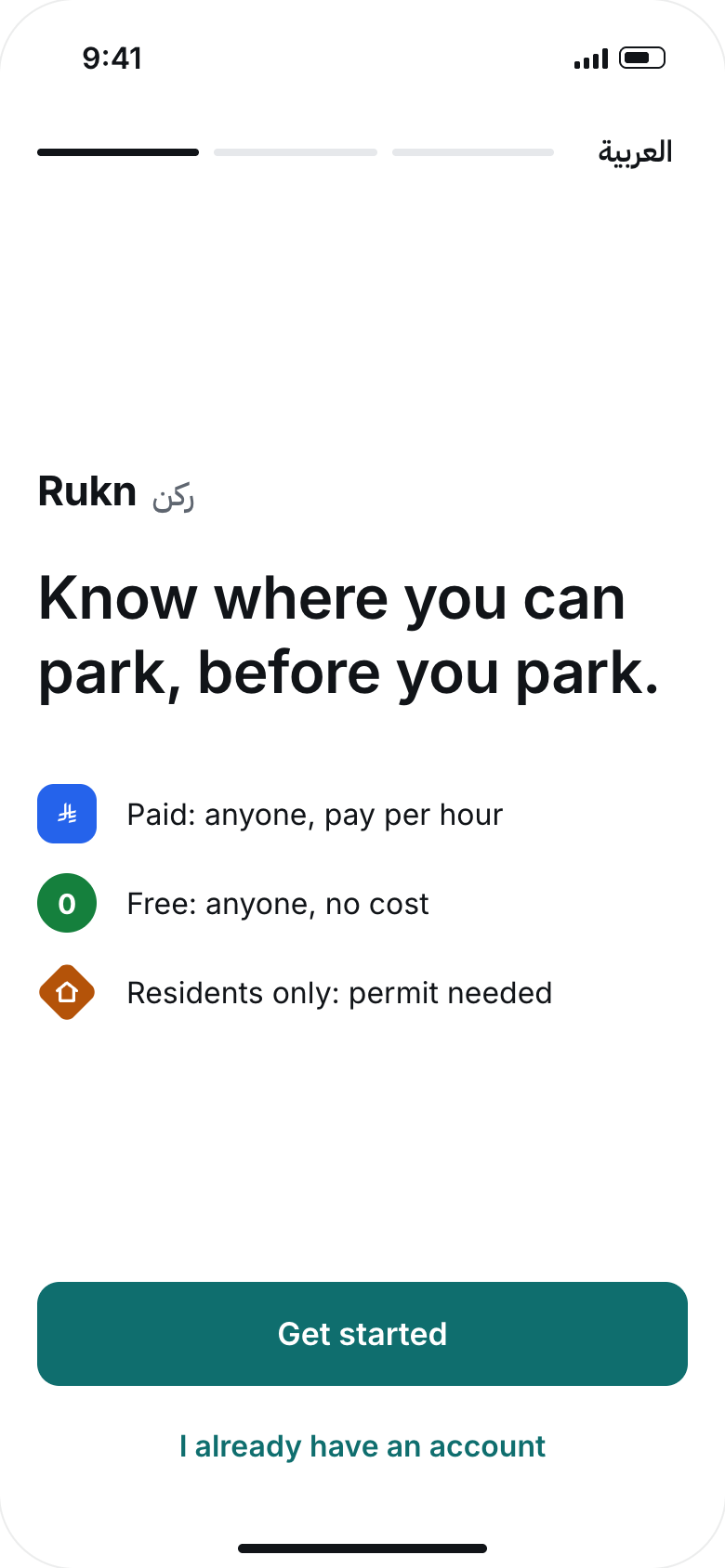
The three parking states are taught before anything else, with the same glyphs the map uses. Arabic is one tap away.
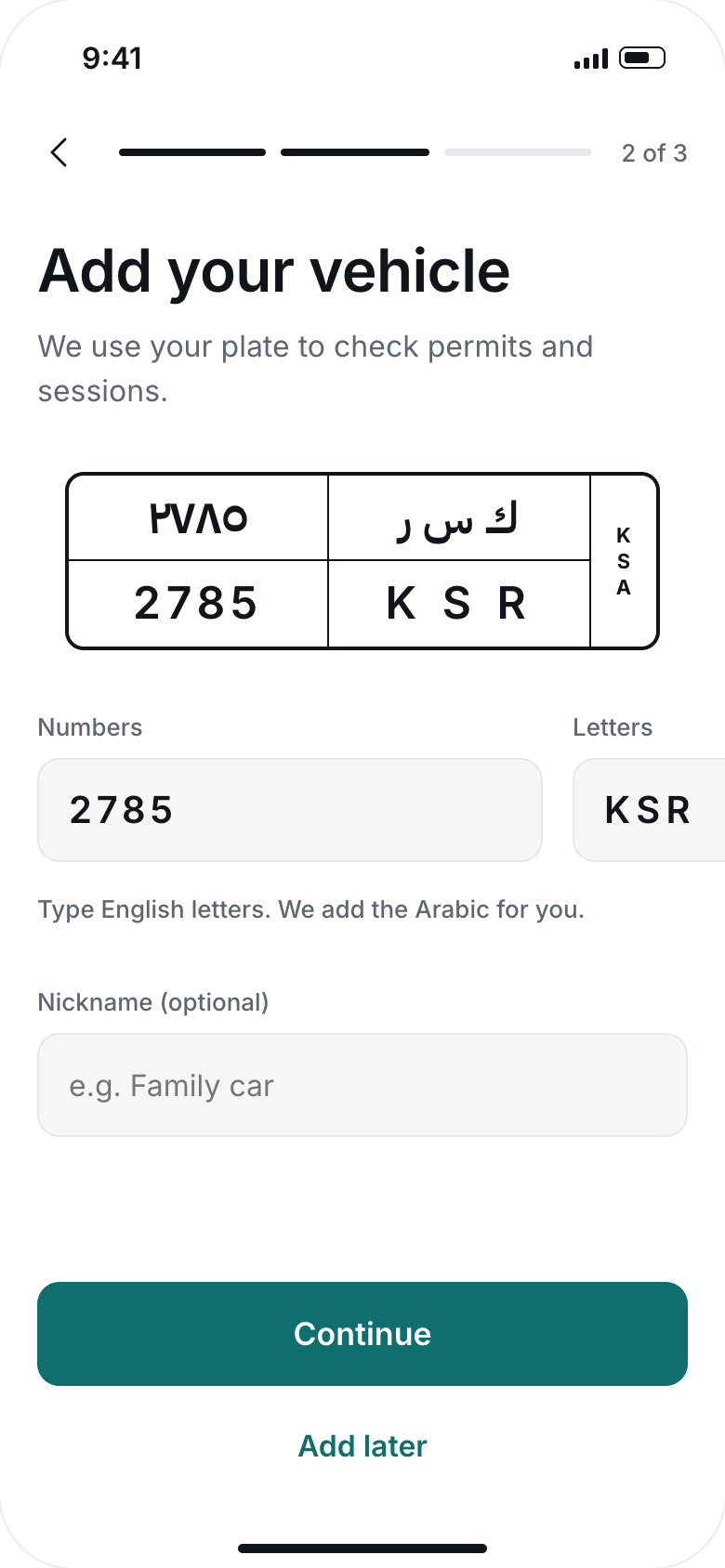
The plate is typed once in English letters and mirrored in Arabic automatically, exactly as it reads on the car.
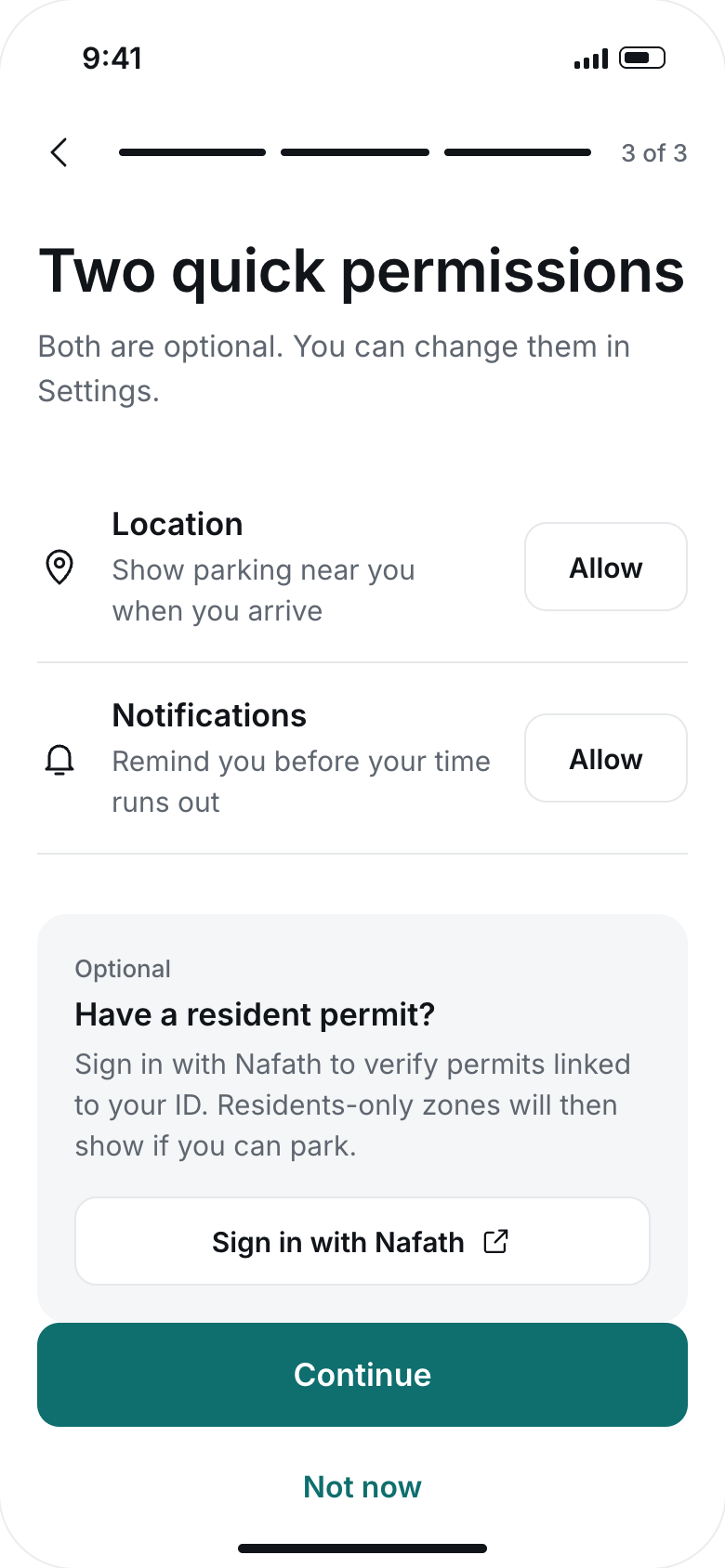
Location and notifications, both optional and both explained. Nafath sign-in is offered for permits, never forced.
Arrive and decide
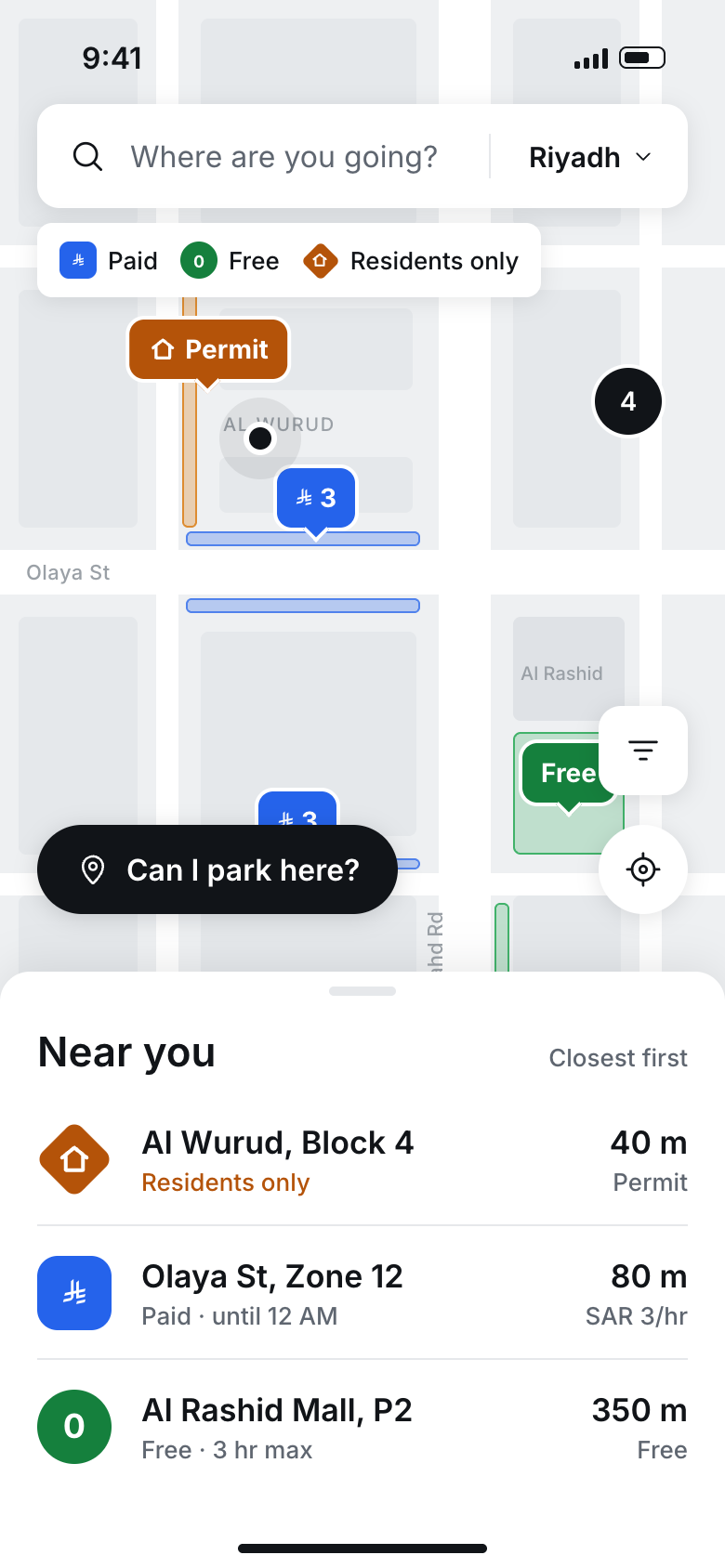
04 – 10Pins carry the price or the rule directly, so a driver reads the street without opening anything.
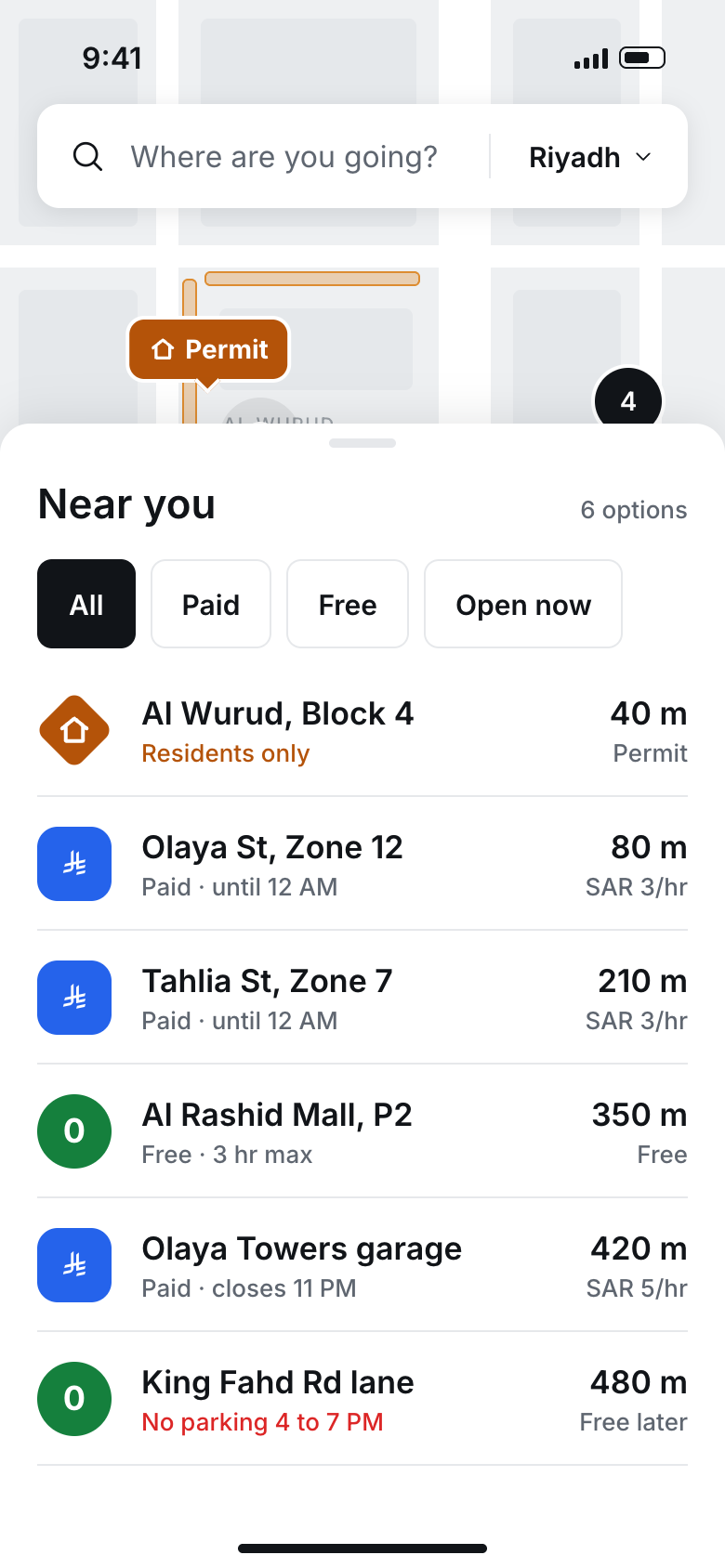
The same zones as a list, sorted by distance, with filters for paid, free and open now.
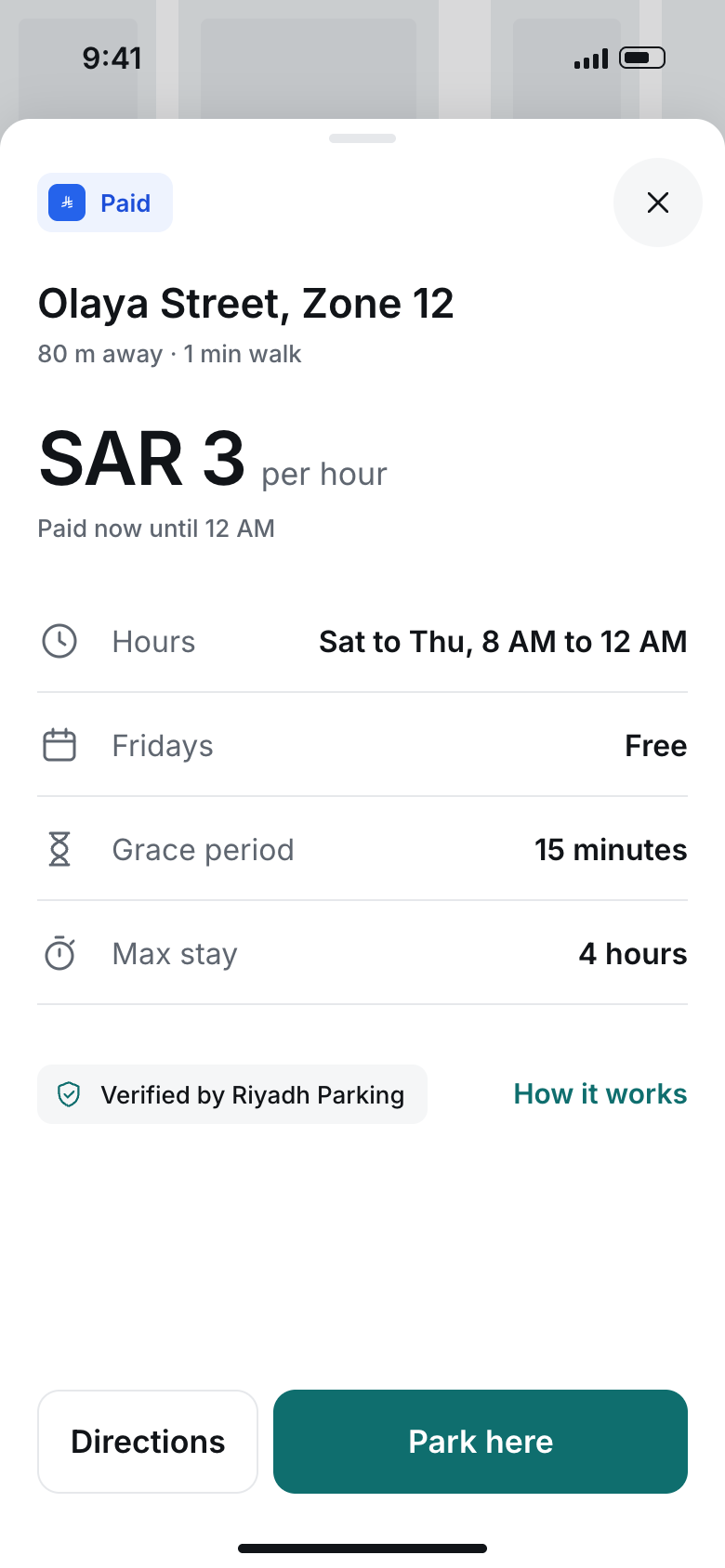
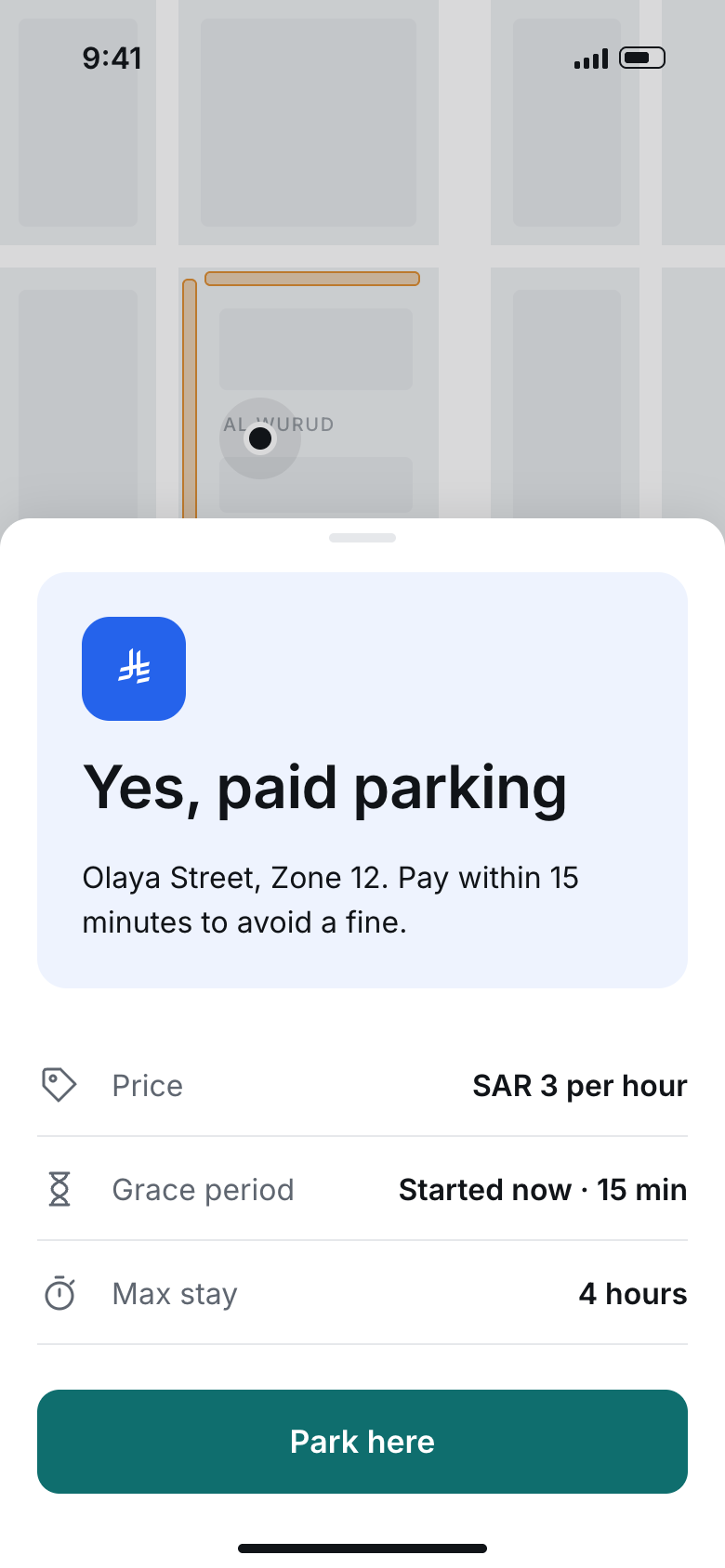
Price, hours, Friday rules, grace period and max stay in one card. All verified by the operator.
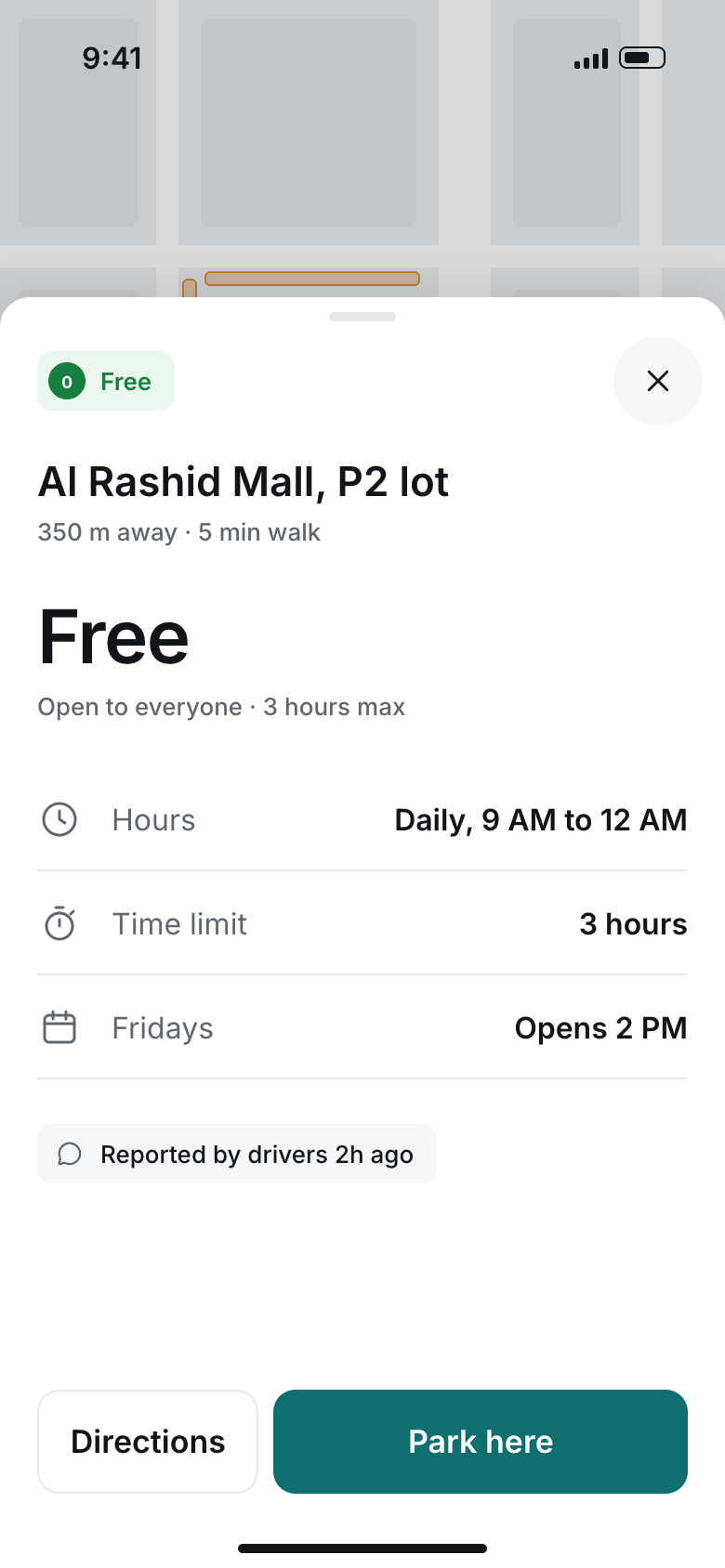
Free still has rules. Time limits and opening hours stay visible so a free spot never turns into a fine.
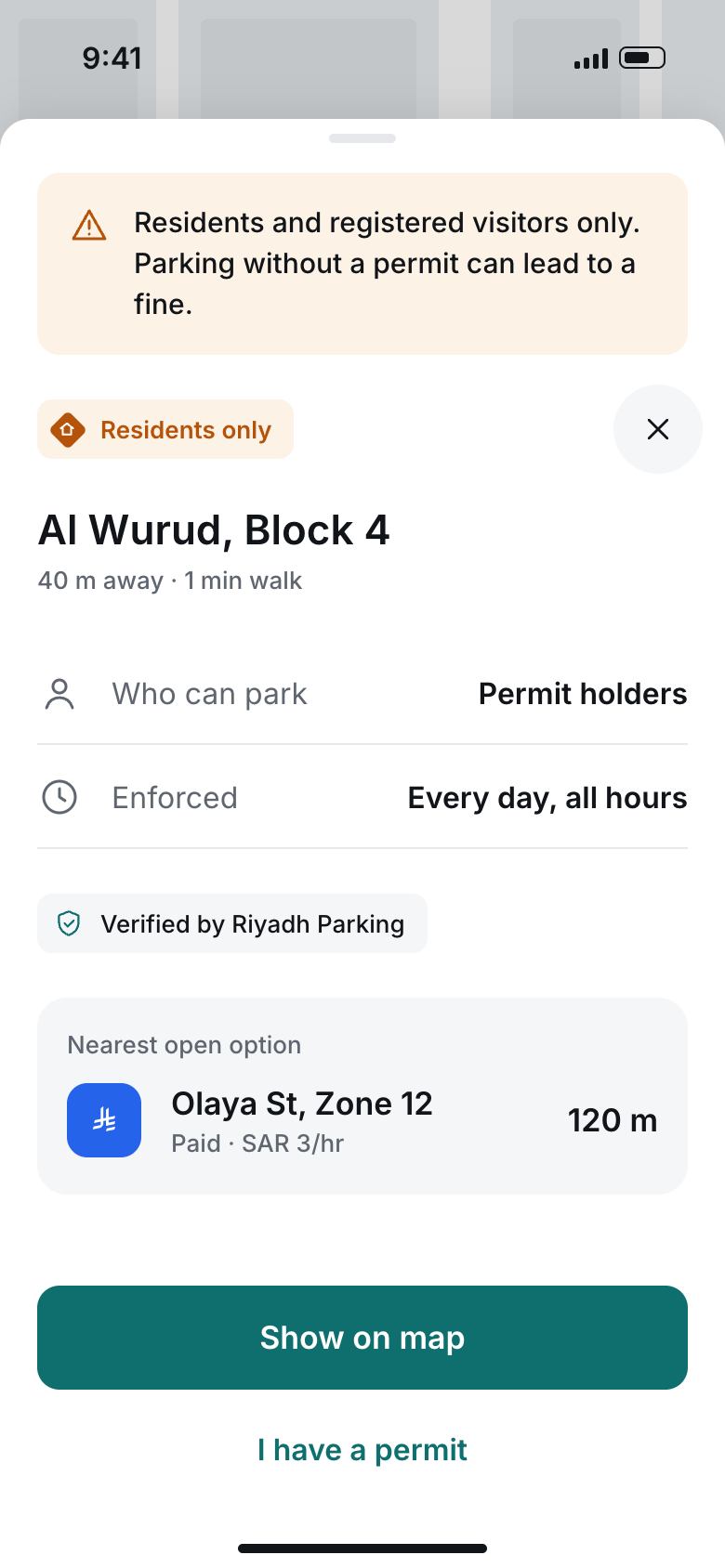
The warning leads the card. The nearest open option sits right under it, one tap to navigate.
"Can I park here?" answered in one word, with the price and the grace period underneath.
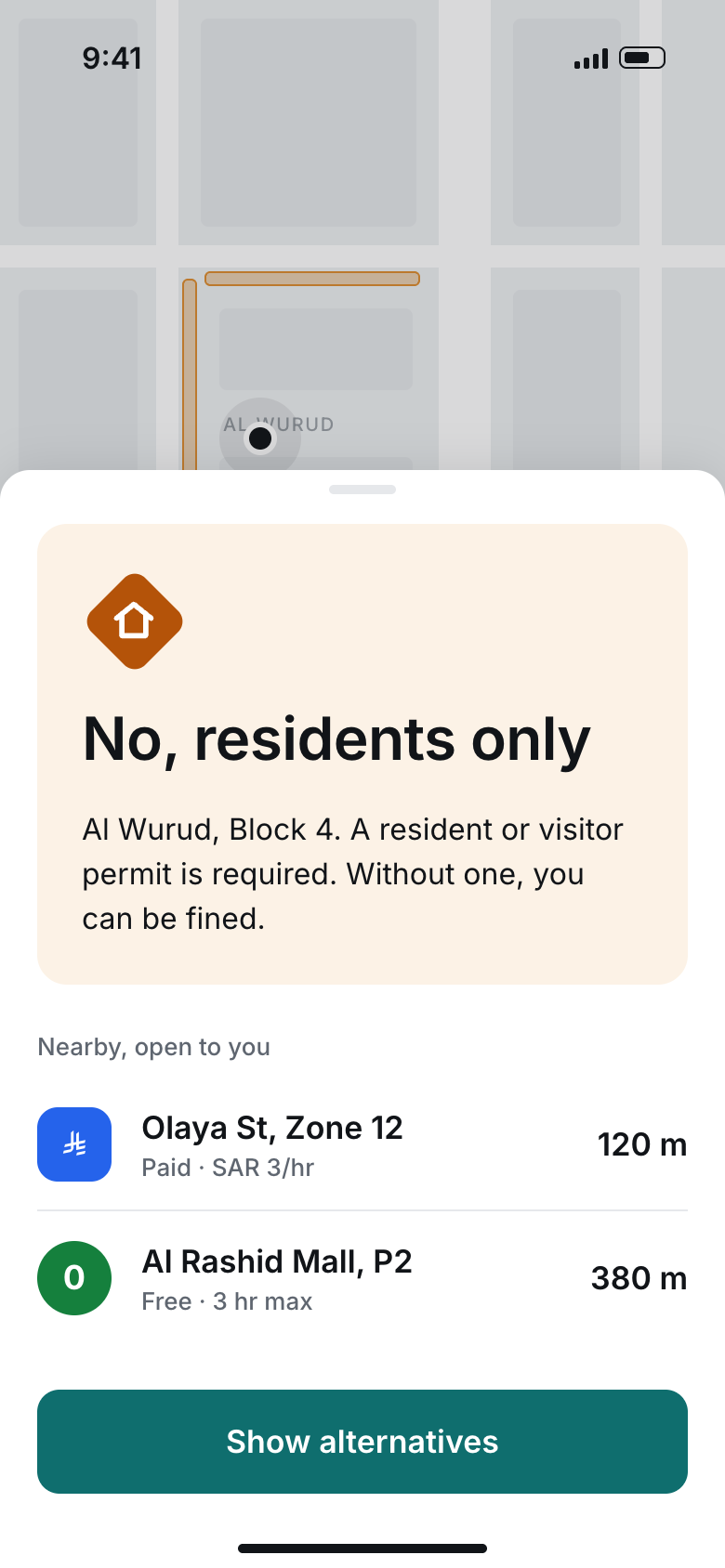
A clear no, the reason in plain language, and alternatives nearby instead of a dead end.
Park and session
11 – 17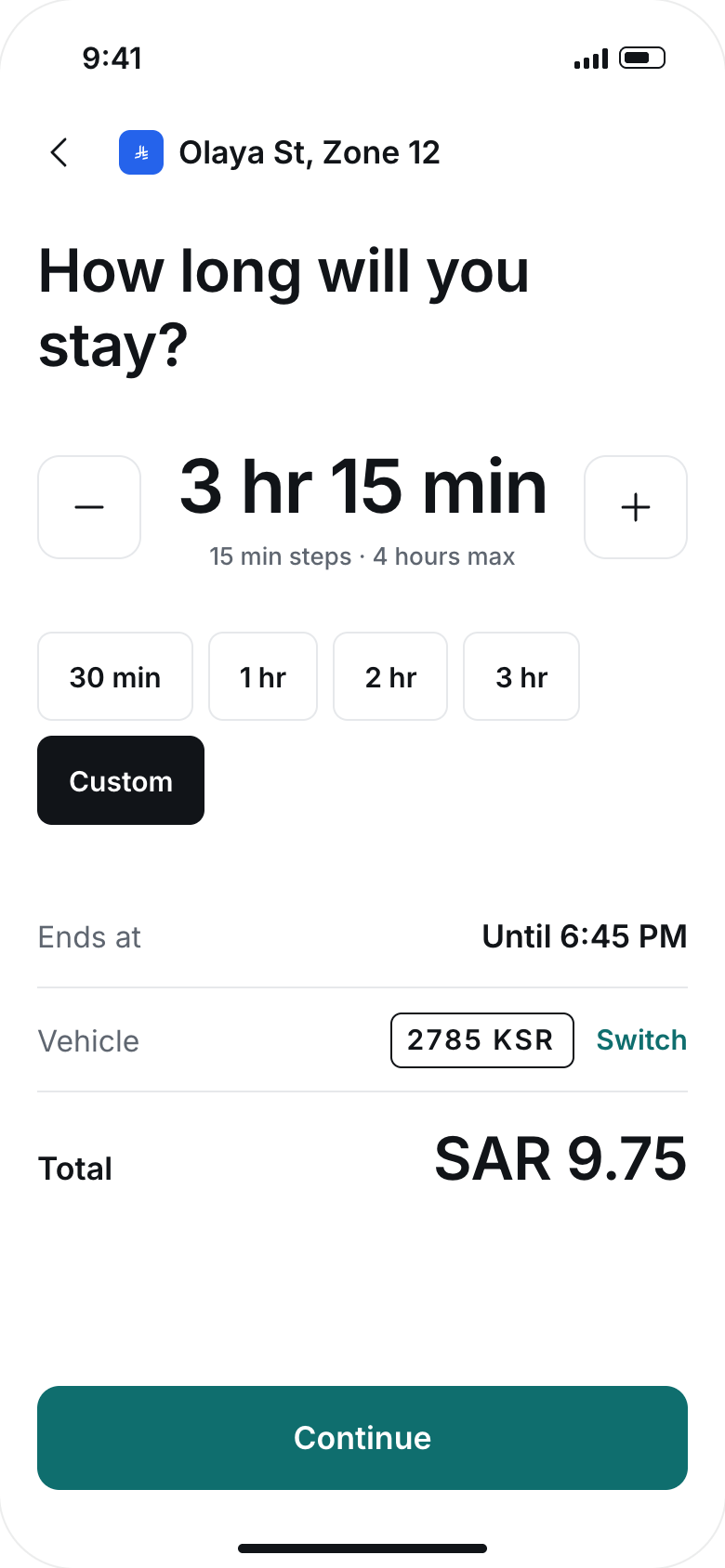
Quick picks or a custom time in 15-minute steps. The end time and total update live as it changes.
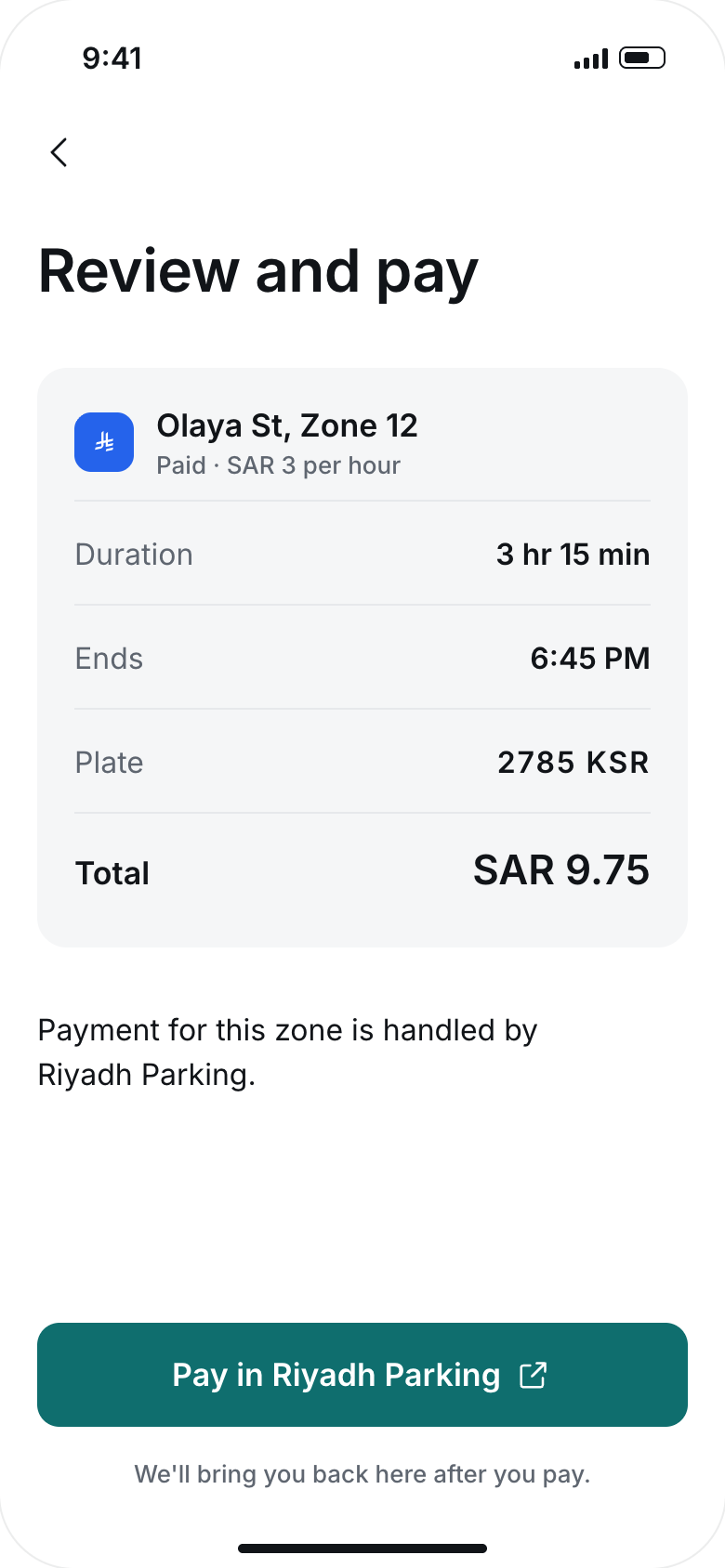
Payment hands off to the city operator. Rukn never holds card details and says so before the jump.
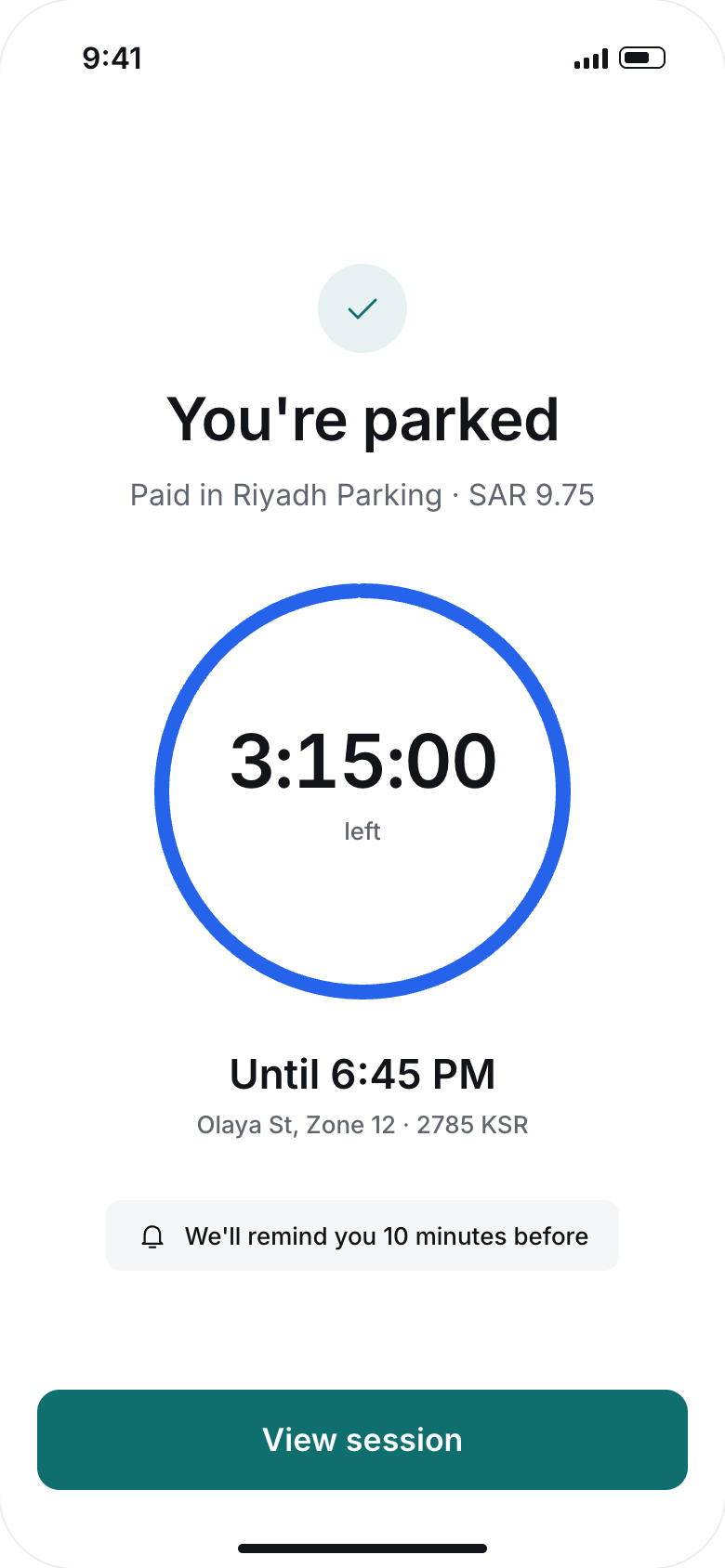
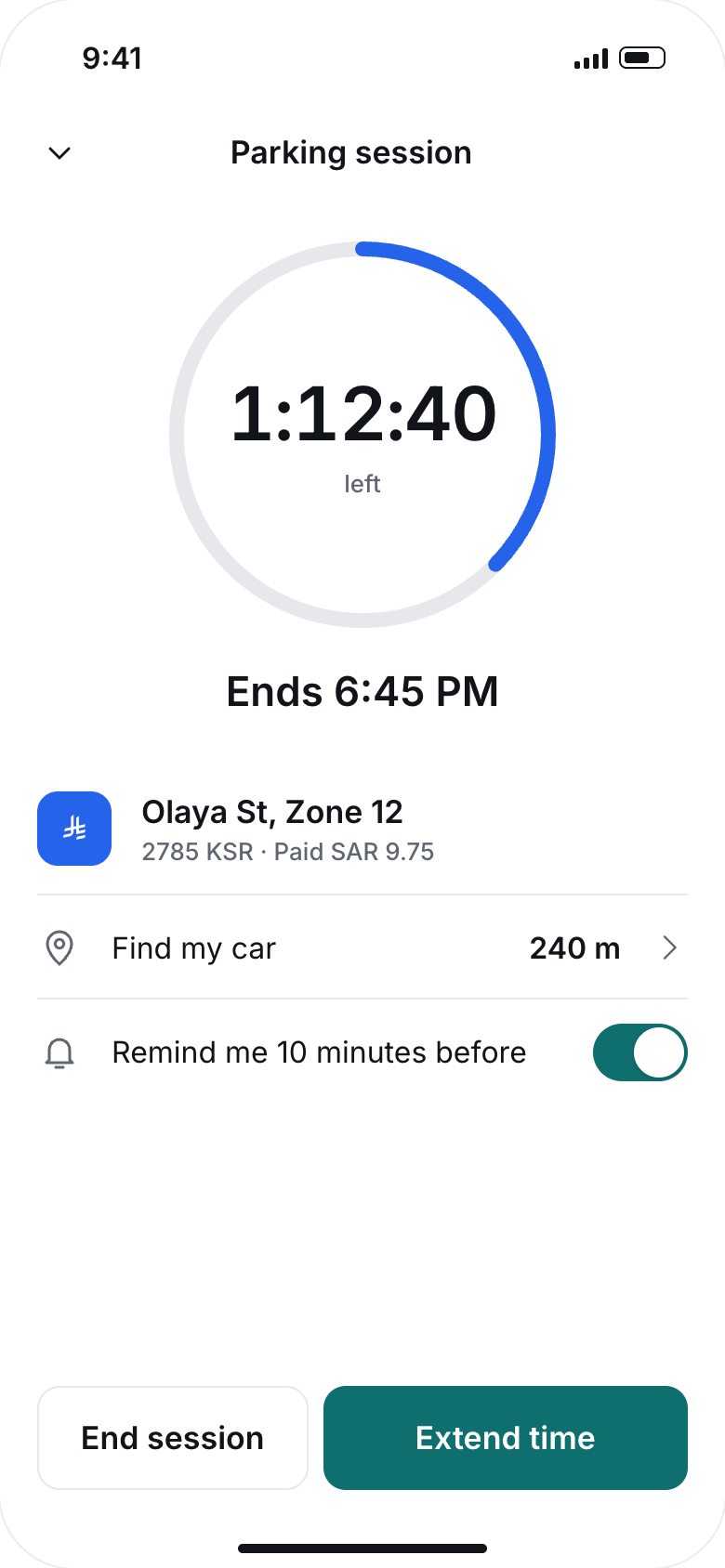
Back from the handoff, the session is confirmed with a countdown and a reminder already set.
Time left, ends at, and where the car is. Extend and end sit at the thumb.
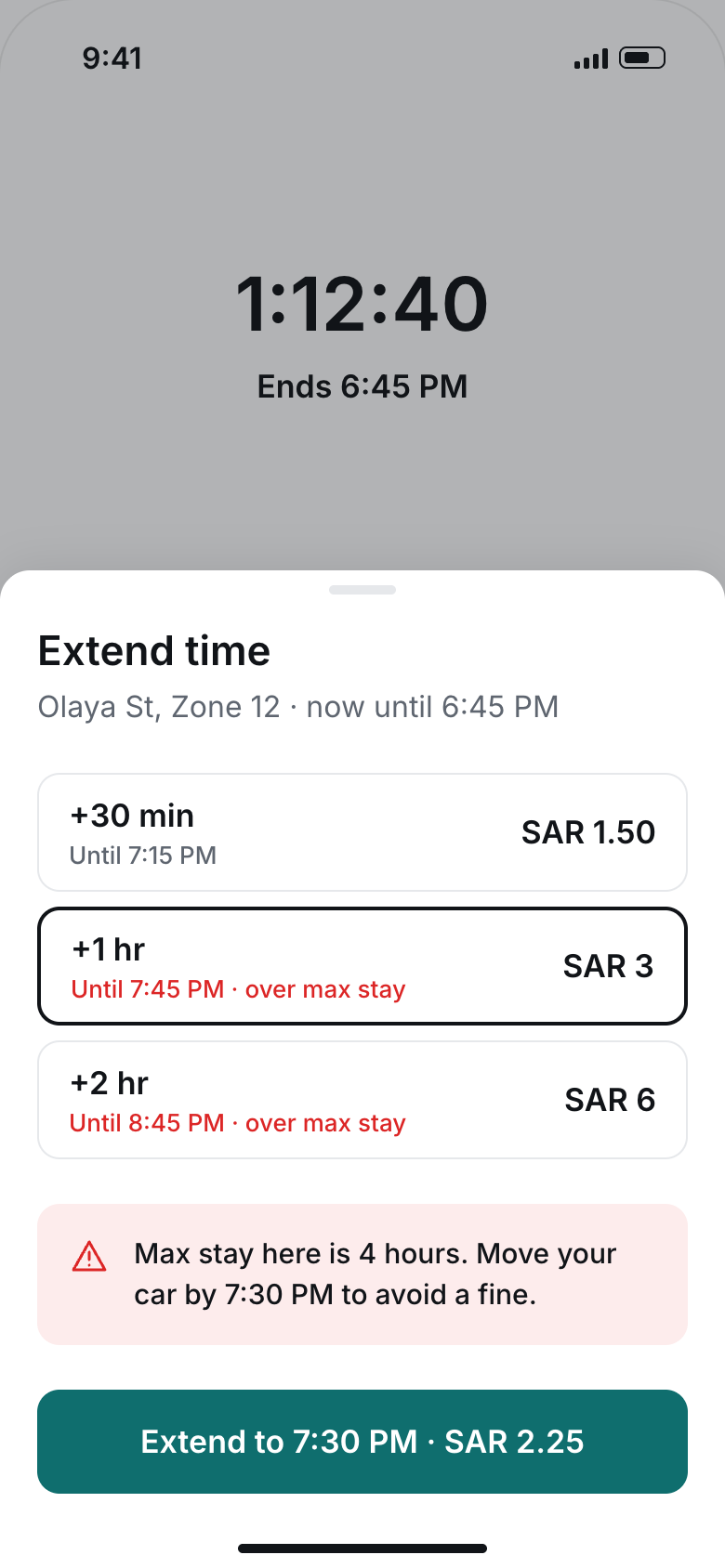
Each option shows its cost and flags anything past the zone max stay before the driver pays for it.
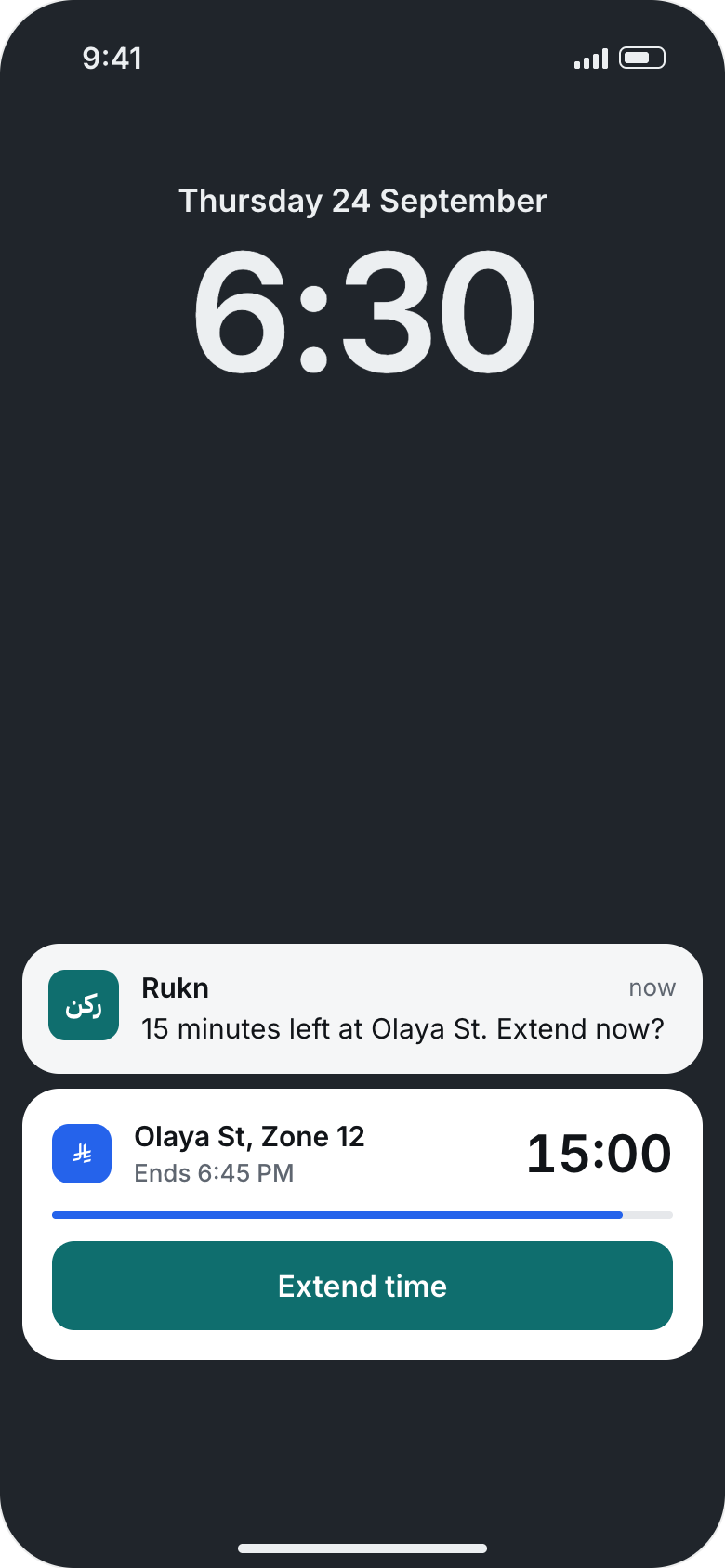
A Live Activity keeps the countdown on the lock screen, with extend one tap from the notification.
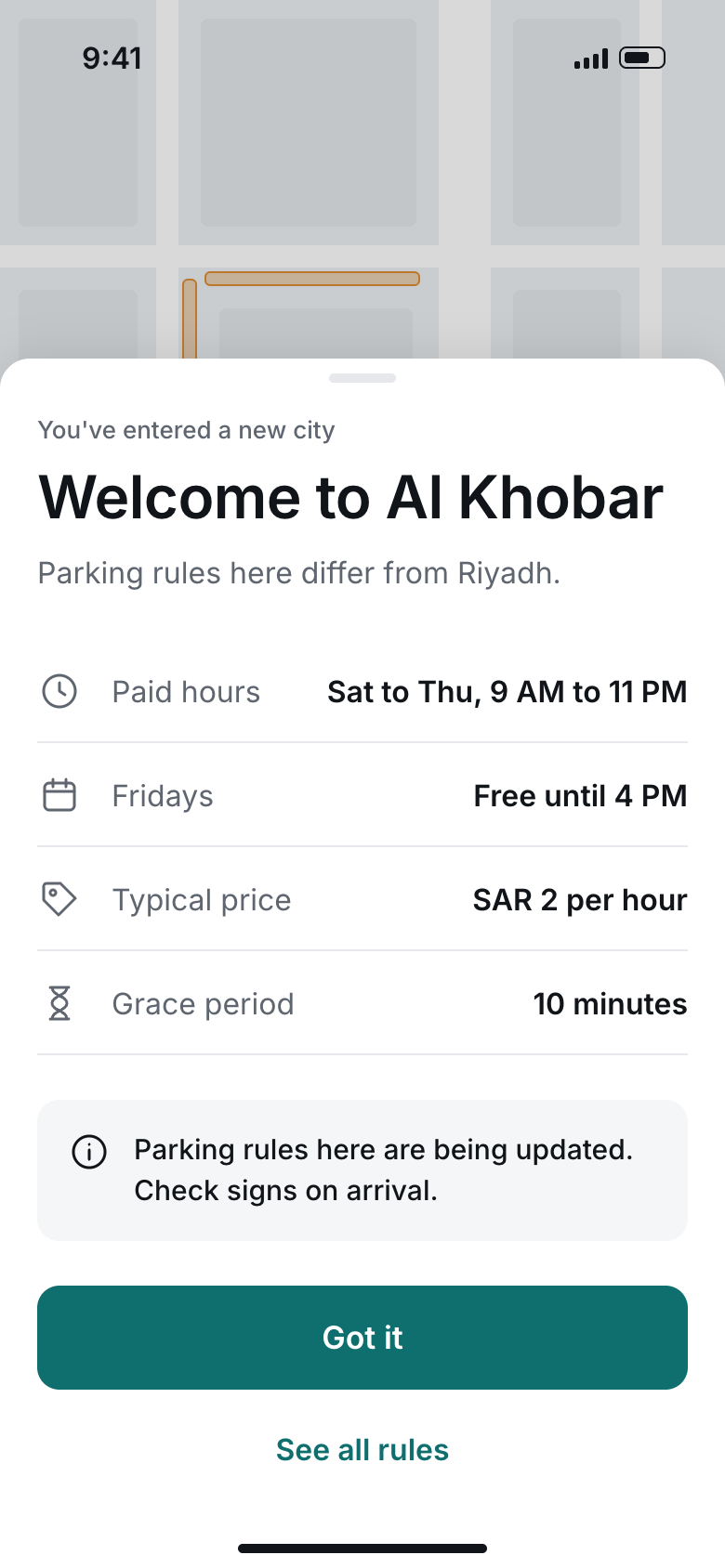
Crossing into a new city shows its rules once, so assumptions from Riyadh don’t carry over to Al Khobar.
Account and edge cases
18 – 23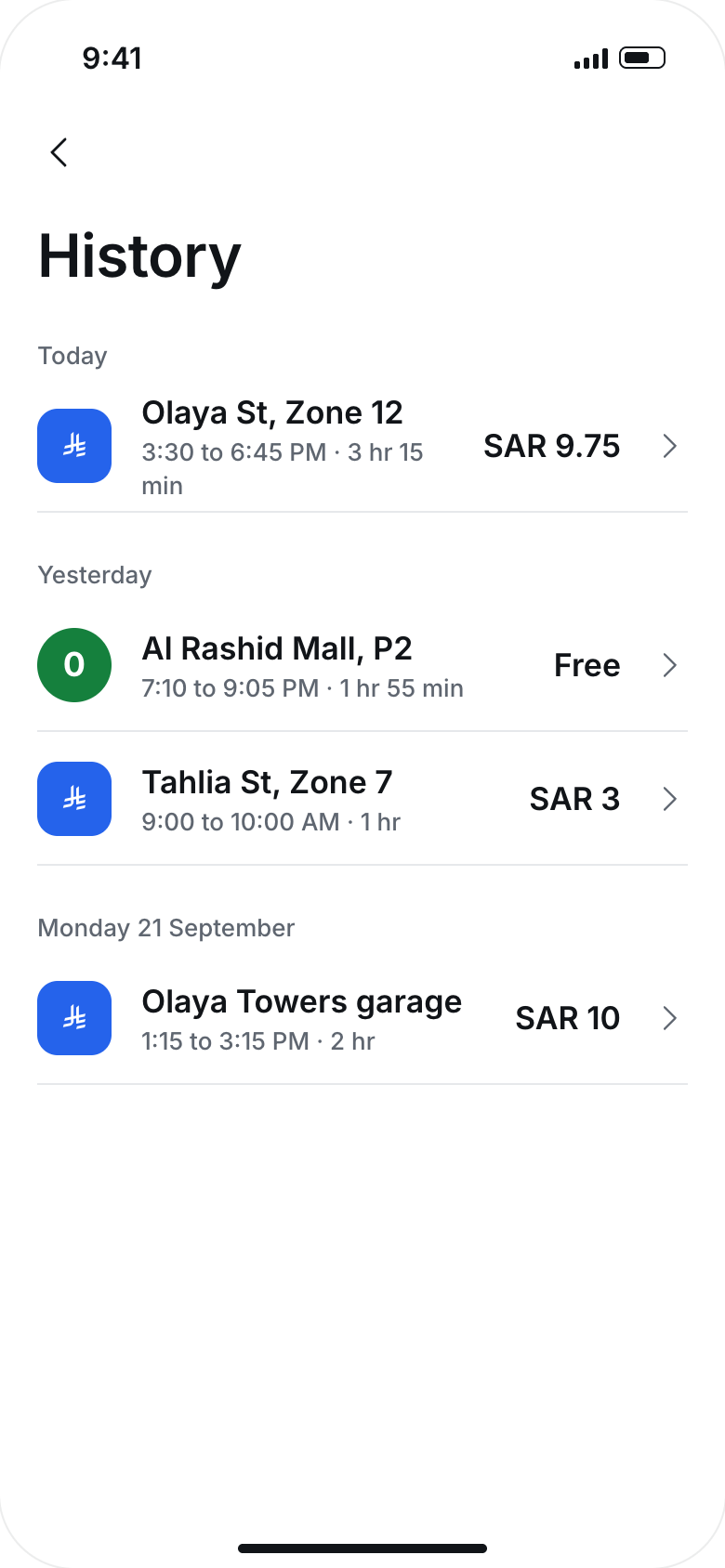
Sessions grouped by day with zone, time and cost. Free sessions are logged too.
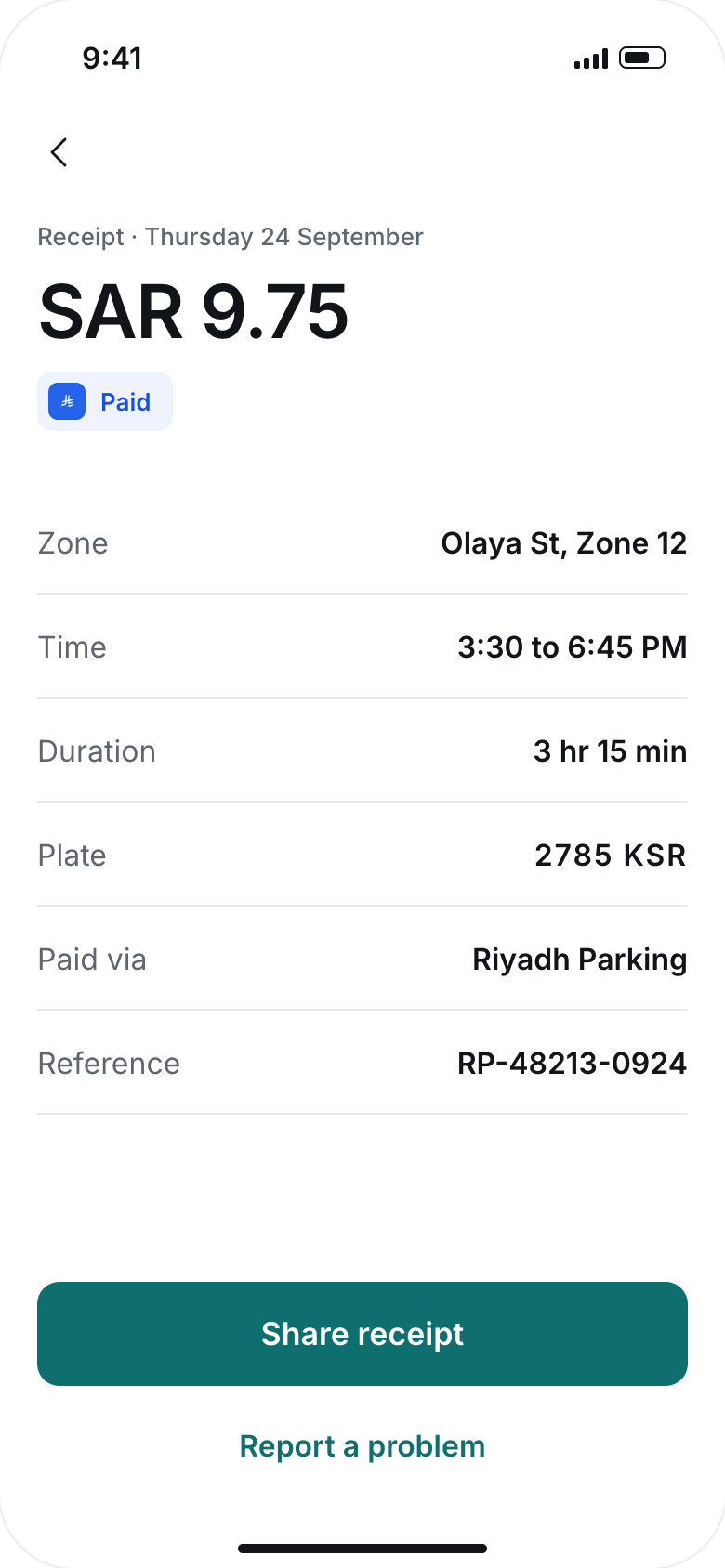
Operator, reference and plate on one screen, ready to share if a fine needs disputing.
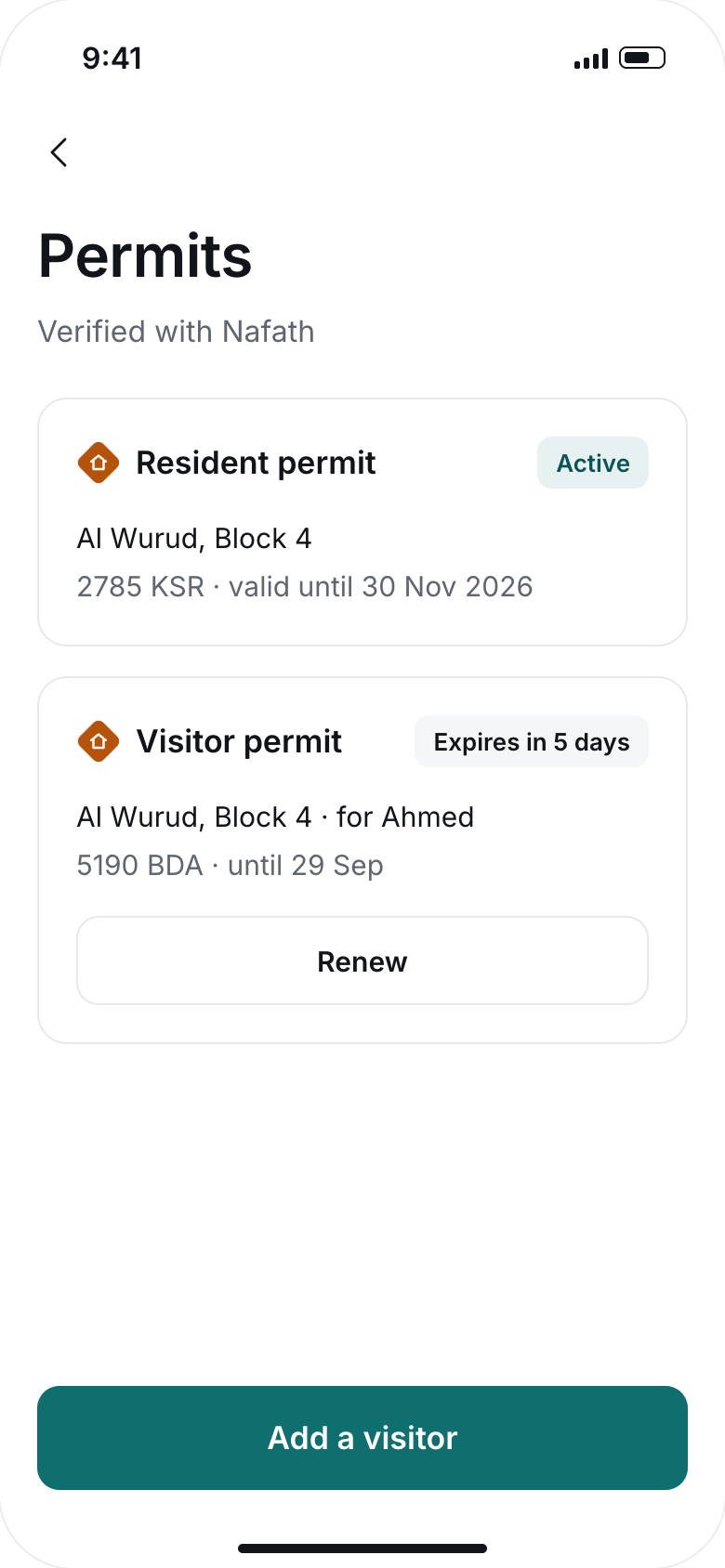
Resident and visitor permits verified through Nafath, with expiry shown before it becomes a problem.
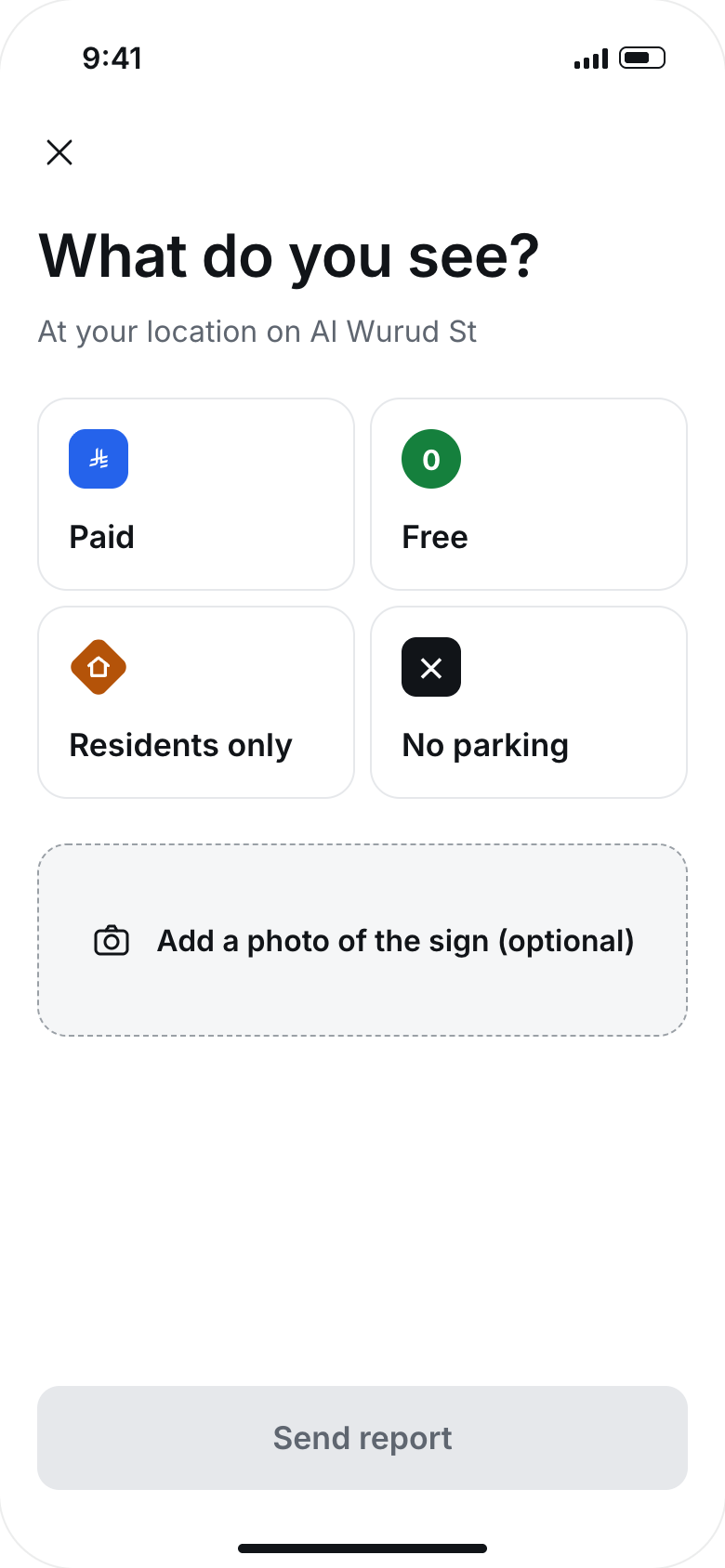
Drivers correct the map by picking what they see, with an optional photo of the sign.
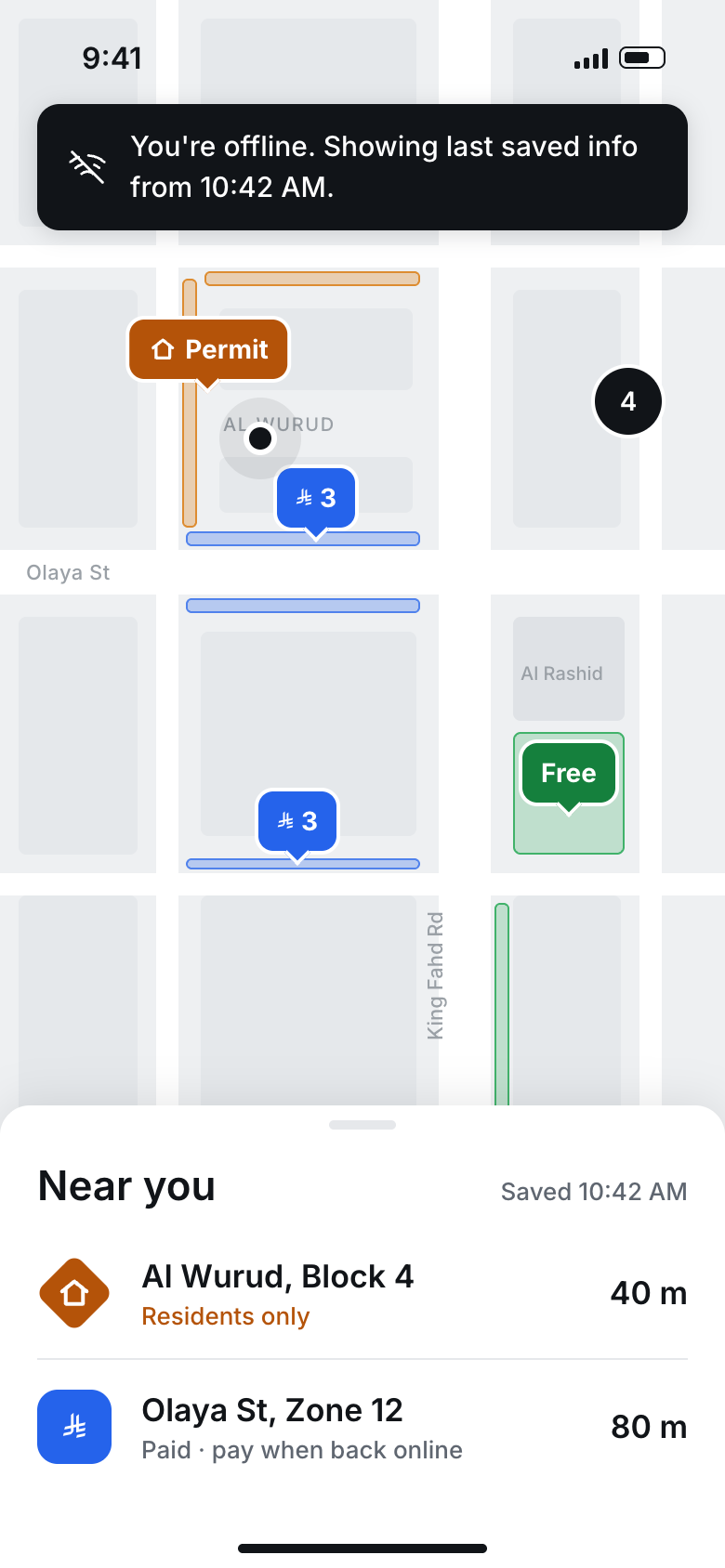
Last saved info stays usable and says how old it is, instead of an empty map.
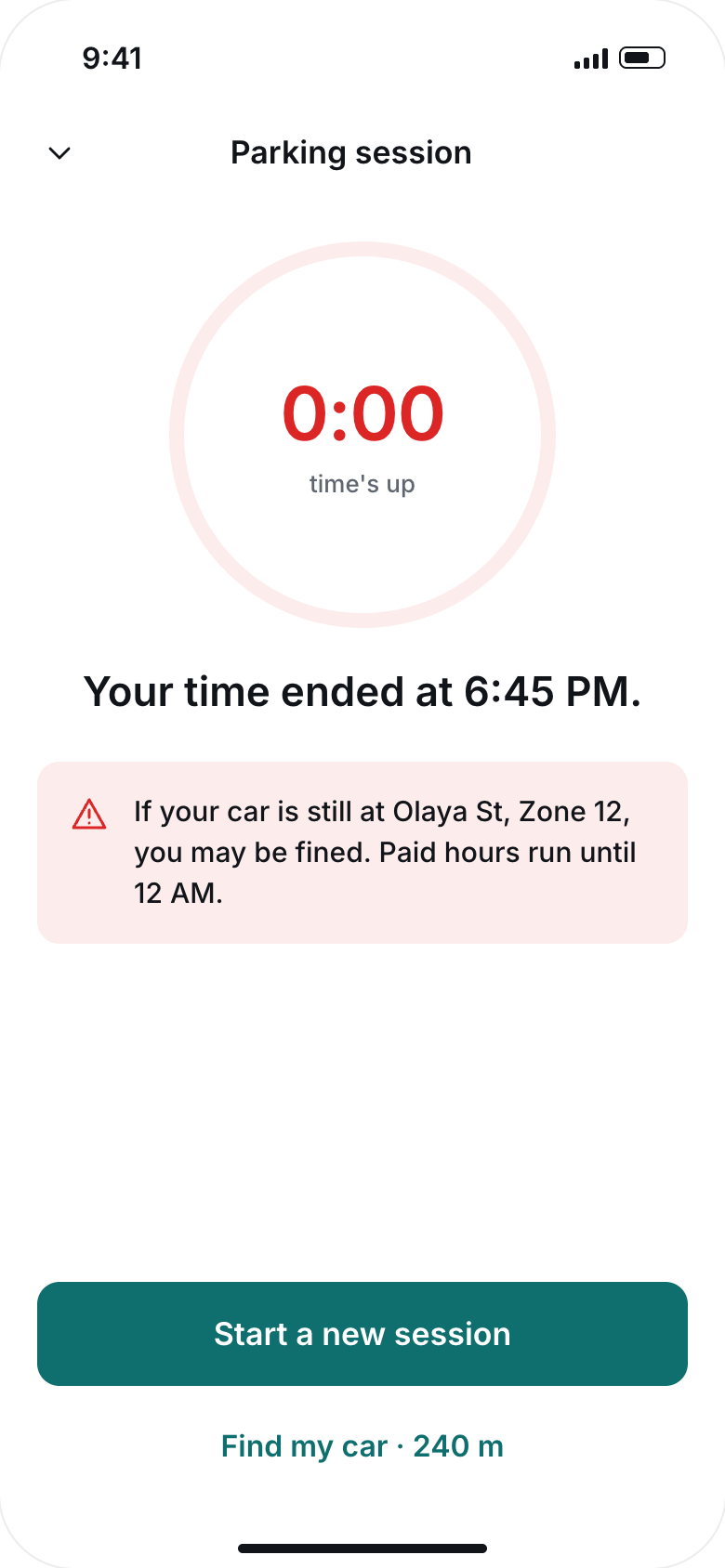
Time’s up is stated plainly with the fine risk, then the fastest way to start again.
Arabic and dark mode
24 – 29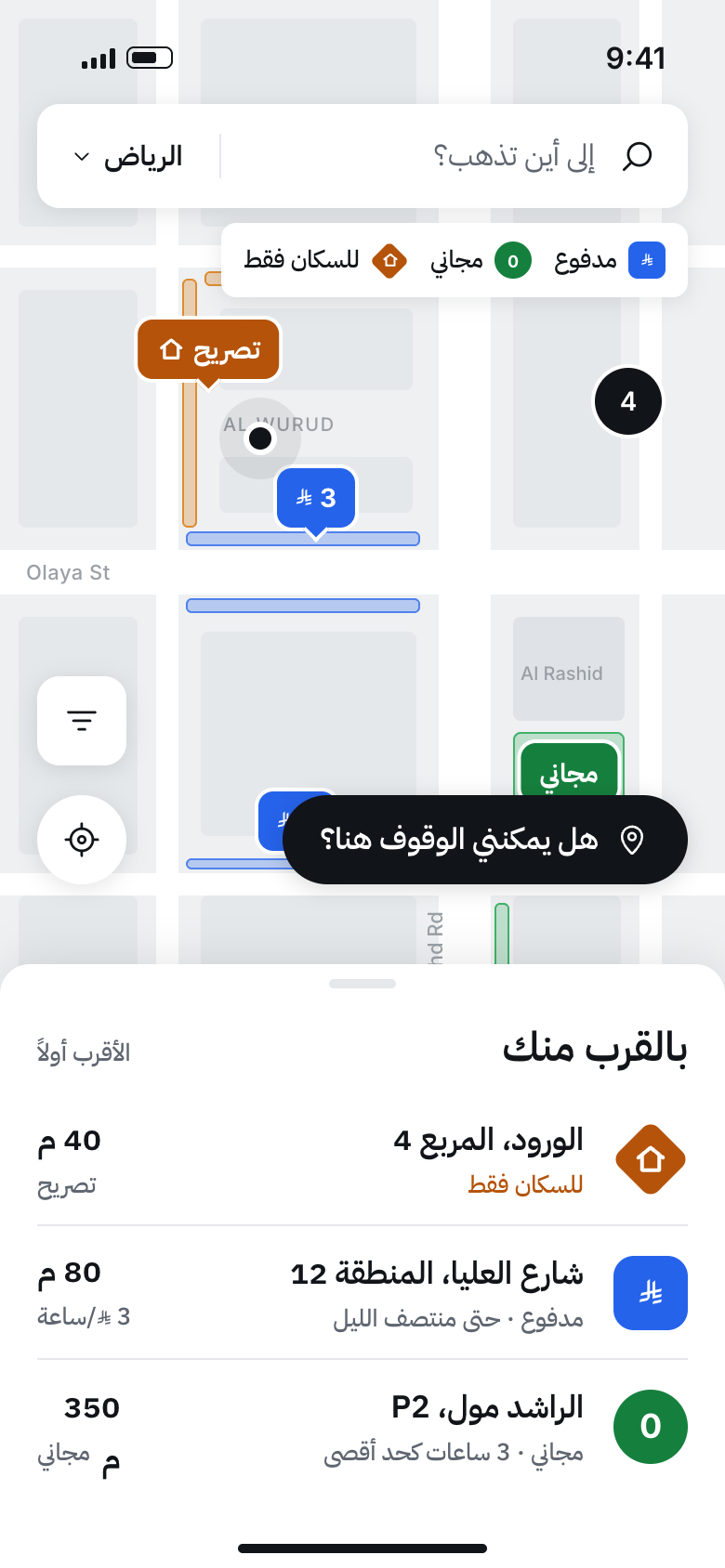
Full right-to-left layout. The map stays geographic while every panel, list and control mirrors.
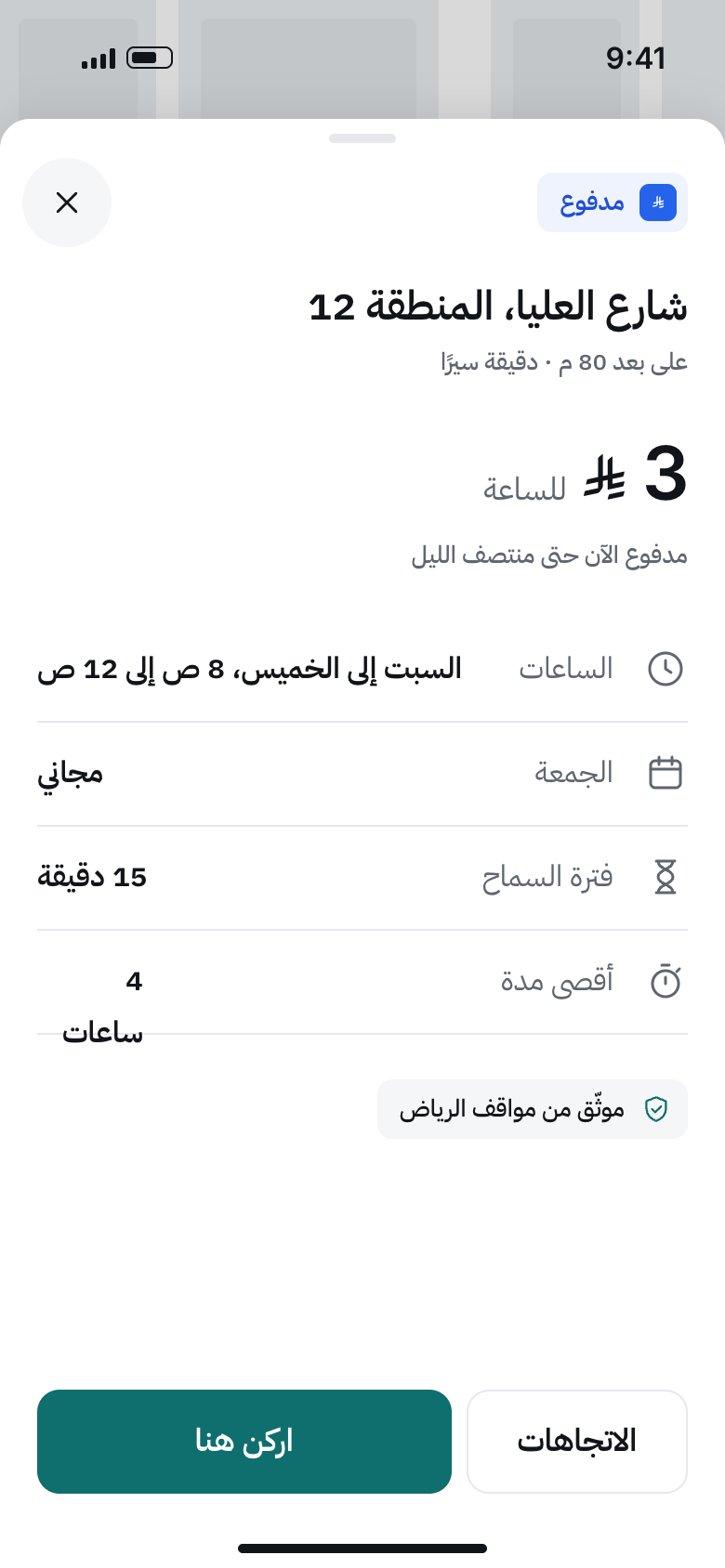
Arabic numerals and the riyal sign sit where an Arabic reader expects them.
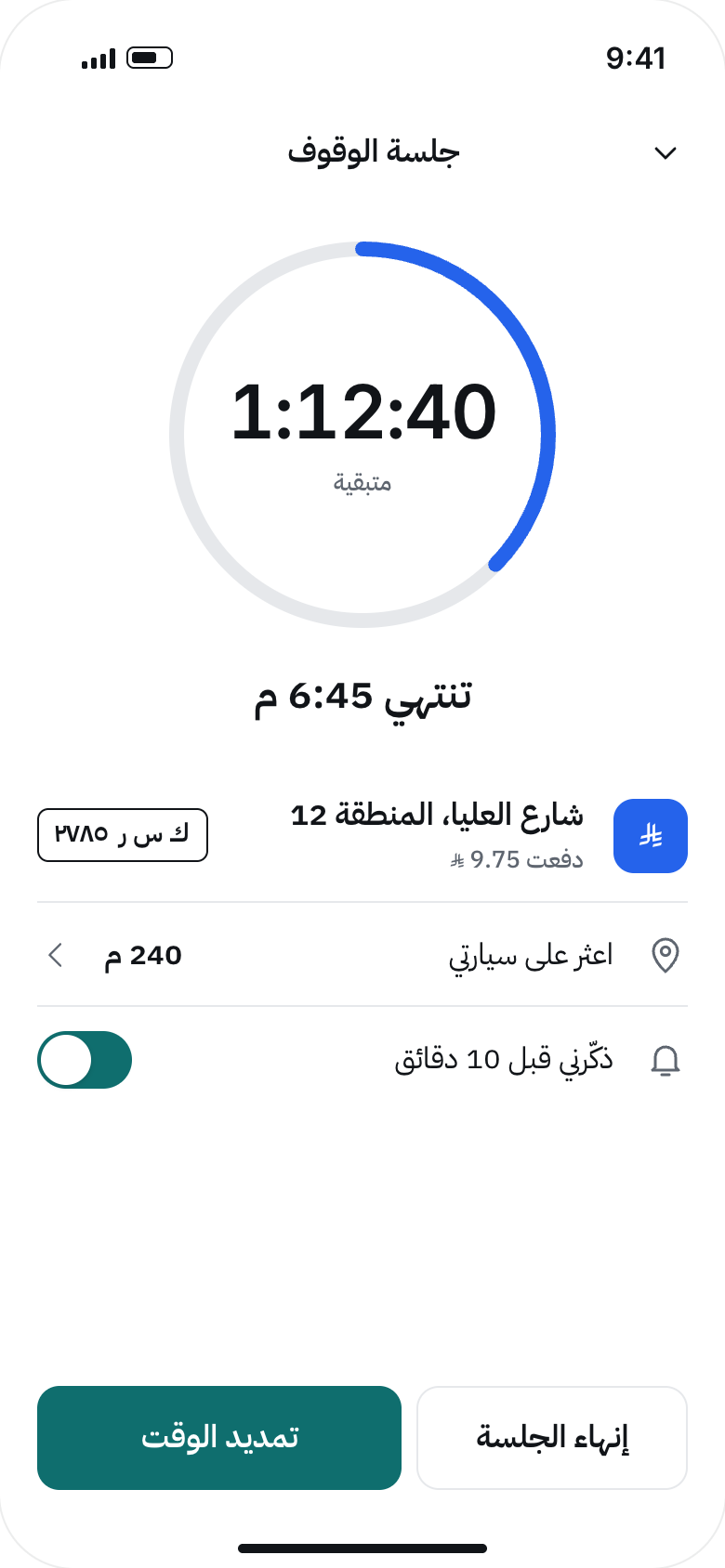
The countdown ring runs the same direction in both languages. Only the layout around it mirrors.
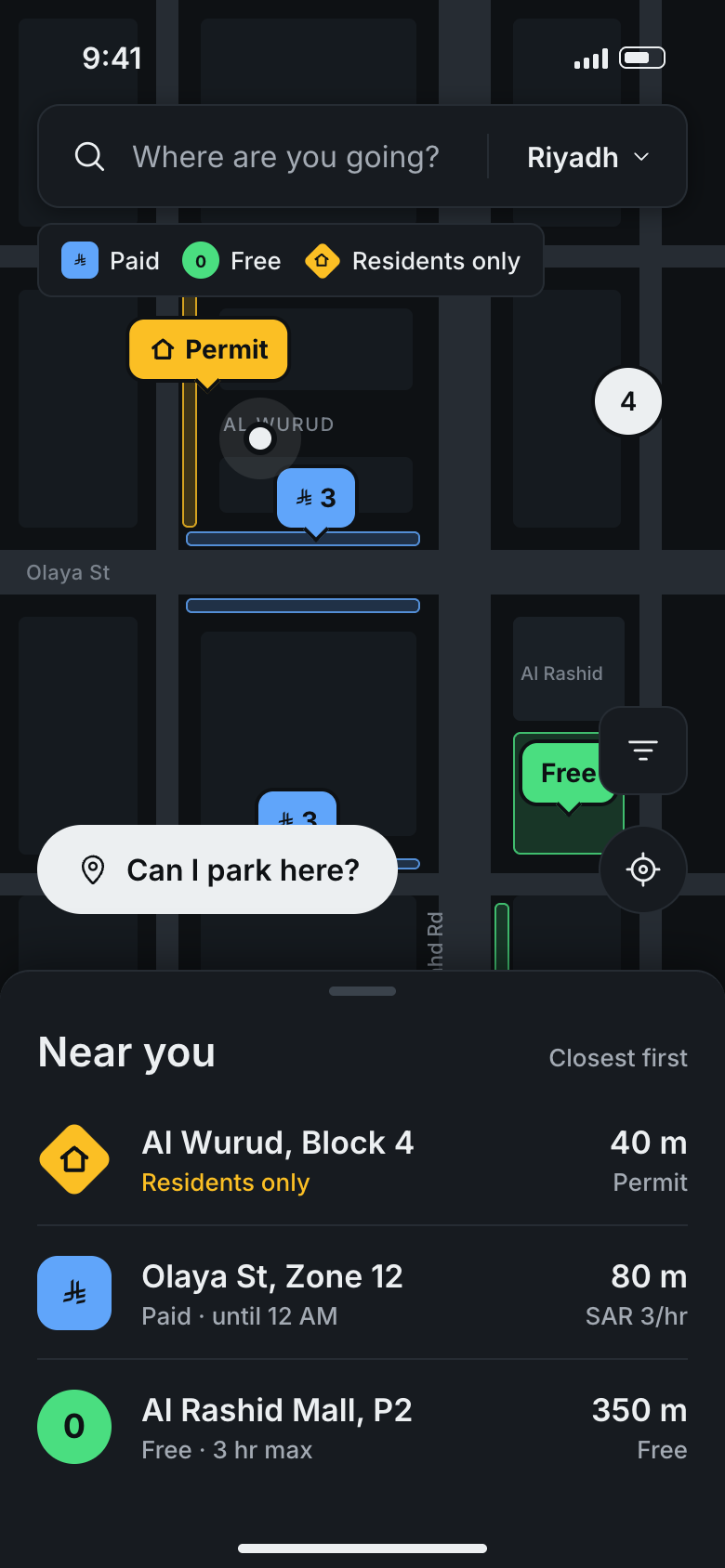
A night palette tuned for the car, with state colours rebalanced so pins still pass contrast.
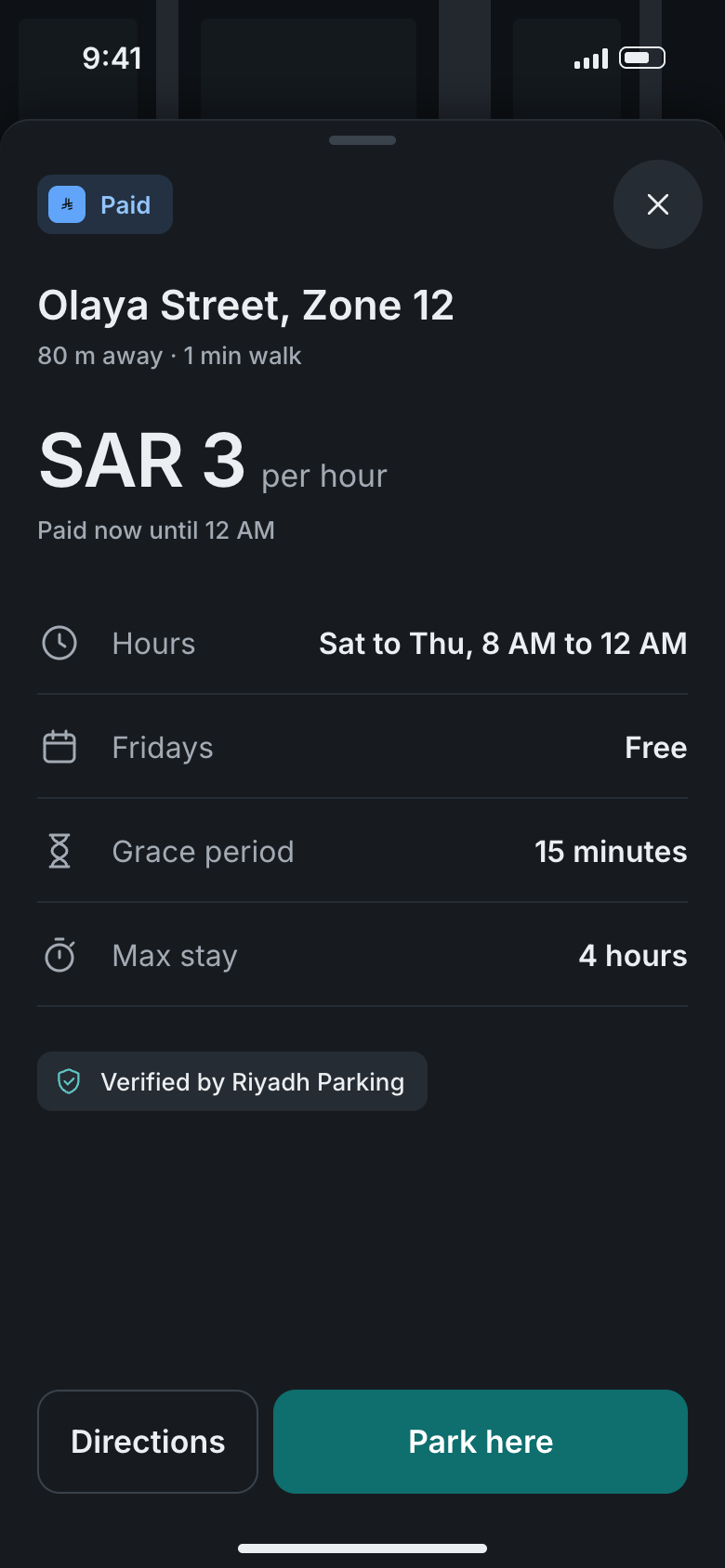
Same card, same order. Nothing moves between themes, so muscle memory carries over.
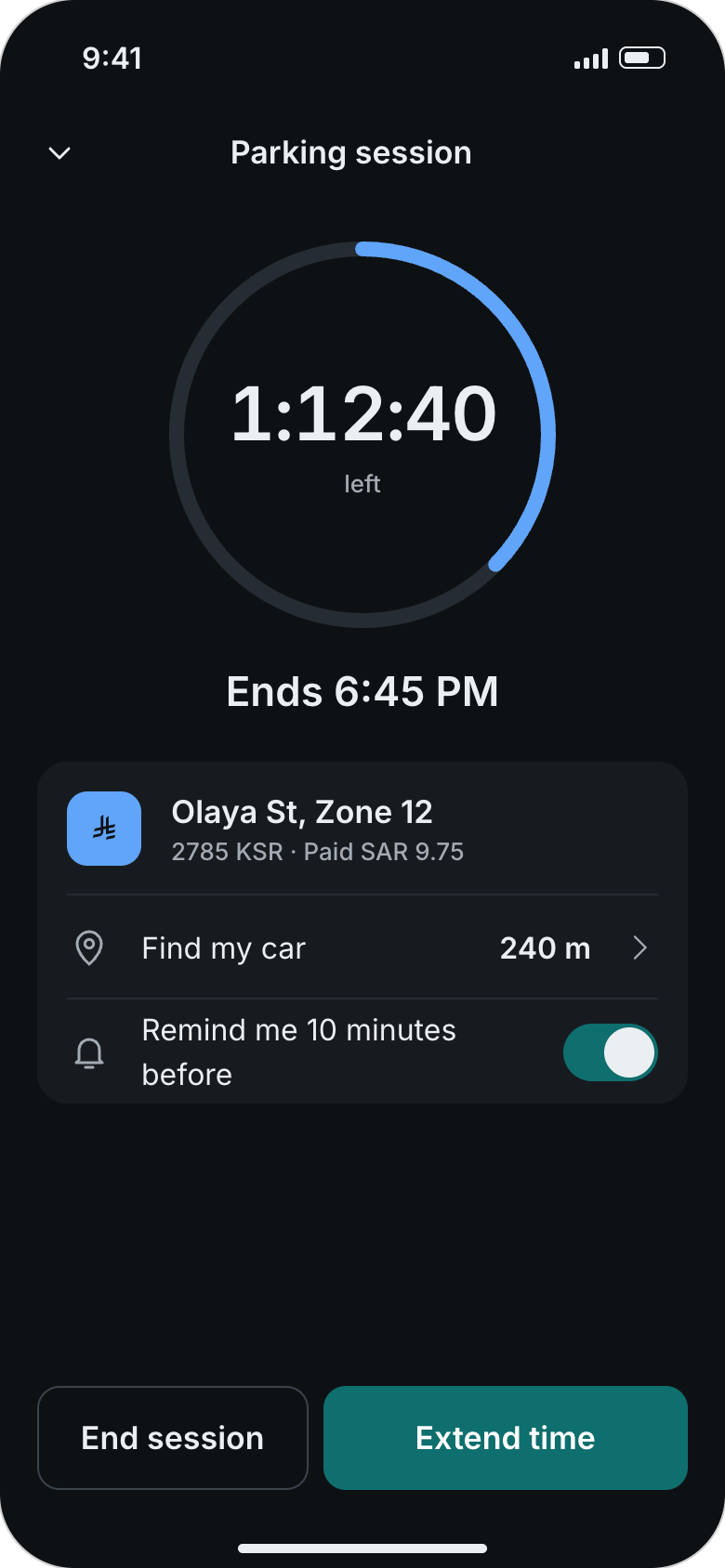
The screen most often checked at night, kept dim without losing the countdown.